
Normal Flow Filtration (NFF+)

All our Pharmaceutical equipment is manufactured using high-precision techniques like computer numeric control (CNC) machining to build specialised machinery that strictly adheres to Good Manufacturing Practice (GMP) standards. This production process relies on durable, hygienic materials like medical-grade stainless steel, which are meticulously cut, shaped, and assembled to ensure absolute safety, corrosion resistance, and operational reliability in cleanroom environments. Each machine is systematically calibrated, tested, and documented to meet rigid regulatory requirements before it is integrated into pharmaceutical production lines to safely process medications.
Pharmaceutical equipment relies on highly specialised, non-reactive materials to prevent contamination and withstand harsh chemical cleaning.
-
316L Stainless Steel: The industry standard for product-contact parts. The "L" stands for low carbon, which prevents corrosion during welding. It also contains molybdenum, making it highly resistant to pitting from chlorides and acids
-
304 Stainless Steel: Used primarily for structural frames, external housings, and non-contact components where extreme chemical resistance is not required
-
PTFE (Teflon) & PEEK: High-performance polymers used for seals, gaskets, and bearings. They offer excellent thermal stability, low friction, and zero chemical leaching


GMP (Good Manufacturing Practice) Design Requirements:
Under GMP guidelines, machinery must be engineered to prevent contamination and allow for effortless sanitisation.
-
Surfaces in contact with product must have a low surface roughness.
-
Equipment must be designed without sharp internal corners, dead legs, or exposed threads where product could get trapped and stagnate. Internal corners are machined with generous radii to allow complete drainage.
-
All welds must be fully penetrated, ground smooth, and polished to be sanitary. Standard threaded fasteners are avoided in product zones; sanitary tri-clamp fittings are used instead.
-
All internal fluid pathways and external surfaces must be sloped for self-draining. This ensures that cleaning solutions drain completely during Clean-in-Place (CIP) cycles, leaving no standing pools.


NFF+ PF No Redundant Filtration


NFF+ PFR Redundant Filtration
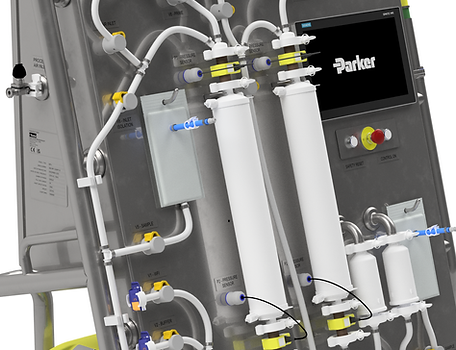
The SciLog® NFF+ PF is a fully automated multipurpose normal flow filtration (NFF) system with on-board pre-use post-sterilisation integrity testing (PUPSIT) in a compact footprint for GMP operating environments.
Designed to be integrated into your downstream bioprocess, the SciLog® NFF+ PF supports compliance to EU GMP Annex 1 (2022) for final fill and bulk filling applications. Combining single-use sensing technology and automation, the system guides the operator through PUPSIT and the bioprocess to minimise user error. The fully automated sequence can be configured to monitor, adjust and record pressure and flow rate to optimise processing times and maximise filter life and efficiency.
The integrated PUPSIT capability allows for the integrity of the filter to be validated before progressing to product filtration.
Equipment designed and manufactured in collaboration with Parker Hannifin Manufacturing - Gas & Filtration Division For more information visit www.parker.com
